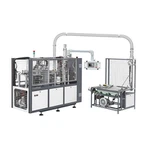
he fully automatic paper bowl machine offers high flexibility in the types of paper bowls it can produce, supporting a variety of common and customized options. Below is a detailed description of the supported types, categorized by different dimensions:
1. Classification by Purpose of Paper Bowls
Catering Paper Bowls
Fast Food Bowls: Used for takeout and in fast-food restaurants to hold staple foods like rice and noodles. Common calibers range from 7–12 ounces (approximately 200–350 ml).
Soup Bowls: Suitable for holding soups and porridge, typically with a larger caliber (12–16 ounces) and deeper design to prevent spills.
Ice Cream Bowls: Shallow in design with a large caliber (16–24 ounces), making them ideal for displaying ice cream shapes.
Industrial/Commercial Packaging Paper Bowls
Sample Bowls: Used for trial packs of cosmetics and small commodities, with a smaller caliber (3–5 ounces).
Chemical Temporary Storage Bowls: Some models can produce chemically resistant paper bowls for short-term storage of non-corrosive industrial raw materials (requires special coated paper).
2. Classification by Paper Bowl Structure
Single-Layer Paper Bowl:
Made of a single layer of coated paper, suitable for lightweight packaging (e.g., cold drinks, dry goods) and cost-effective.
Double-Layer/Multi-Layer Paper Bowl:
Formed through multi-layer paper composite molding, it enhances thermal insulation and strength, making it suitable for hot drinks (e.g., coffee, milk tea) or high-temperature foods.
Paper Bowl with Partition:
Features a partition structure inside the bowl to hold different foods simultaneously (e.g., main dishes + side dishes). Requires a customized mold.

3. Customized Classification by Paper Bowl Specifications
Caliber and Depth:
Common calibers range from 3–24 ounces (approximately 90–700 ml). Some models support fine-tuning (e.g., ±5 mm).
Depth adjustment: Shallow (e.g., ice cream bowls) or deep (e.g., soup bowls) designs can be achieved by changing the mold.
Shape and Appearance:
Round Paper Bowl: The mainstream shape, suitable for most application scenarios.
Special-Shaped Paper Bowl: Such as square or hexagonal (requires a custom mold), ideal for brand differentiation.
Printing Customization: Supports printing brand logos, patterns, or QR codes on the bowl body (requires flexographic or digital printing equipment).
4. Classification by Environmental Protection Needs
Traditional Paper Bowls:
Use PE (polyethylene)-coated paper, which is waterproof and oil-resistant but not degradable.
Environmentally Friendly Degradable Paper Bowls:
Compatible with bio-based coated papers such as PLA (polylactic acid) and PBAT (polybutylene adipate/terephthalate), meeting plastic restriction requirements.
5. Classification by Production Efficiency and Degree of Automation
General Paper Bowl Machine:
Supports fast switching between multiple specifications (e.g., mold replacement within 30 minutes), suitable for small- to medium-batch production.
High-Speed Specialized Paper Bowl Machine:
Optimized for a single specification (e.g., producing only 12-ounce fast food bowls), with speeds up to 120–150 pieces per minute, ideal for large-scale orders.